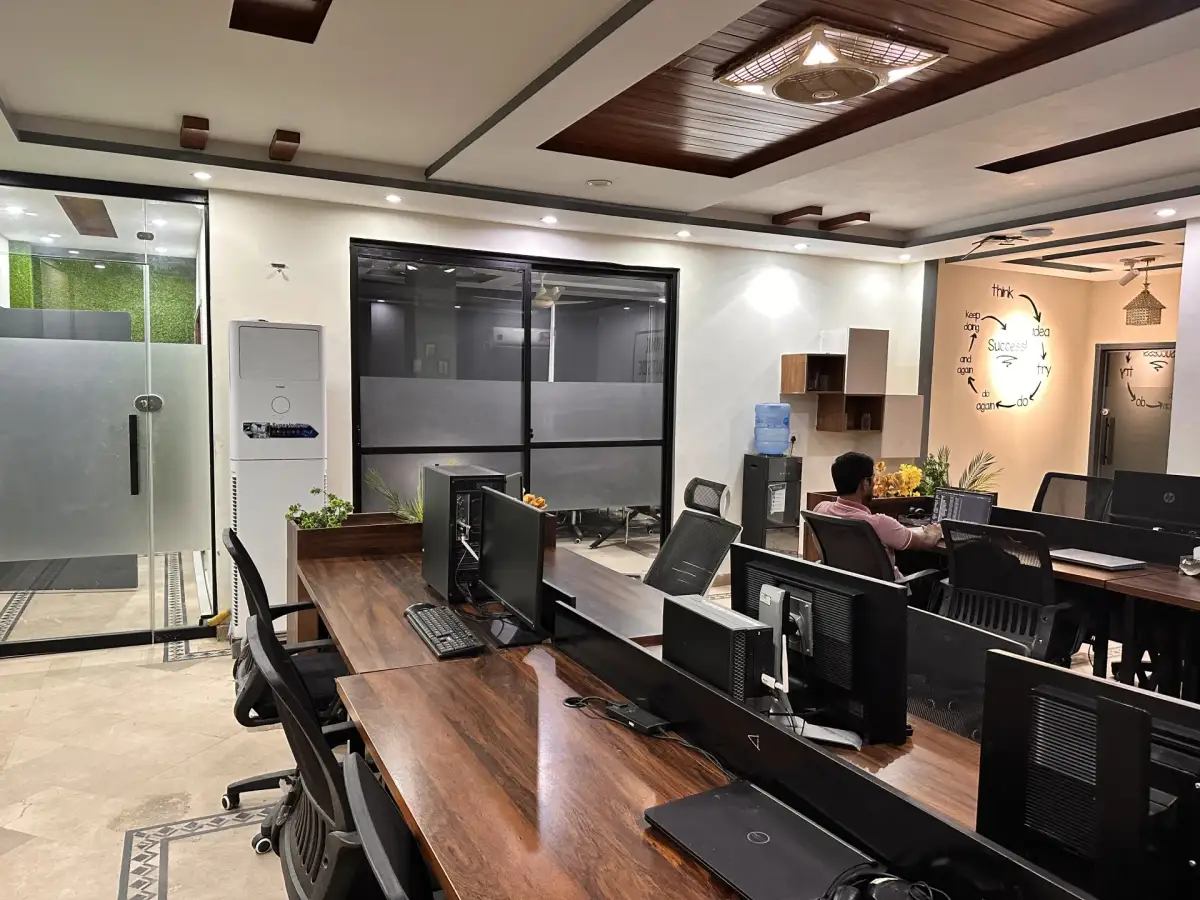
A headquarters built for Lahore's varied commercial economy
Our base in Faisal Town places the team within Lahore's central commercial network, with practical access to Gulberg, Johar Town, Model Town, DHA and the city's major education and healthcare corridors. More importantly, the office brings channel specialists into the same operating rhythm. Strategists can question a lead definition with media buyers, SEO specialists can raise a landing-page constraint with developers, and designers can see which creative angle is producing qualified conversations. That coordination matters more than merely claiming every digital service on a proposal.
Lahore businesses range from owner-led stores to corporate groups with formal procurement and several approvers. We adapt governance accordingly. A restaurant group may need rapid creative approvals around a launch or Ramadan offer; a hospital requires careful claims review and appointment tracking; an education provider has fixed admissions windows; and a B2B manufacturer may judge success by a small pipeline of valuable enquiries. The commercial objective, not the platform, determines the reporting model.
How people in Lahore discover and assess businesses
Search behaviour is highly specific. Buyers look for products and services with neighbourhood names, nearby landmarks, opening hours, delivery coverage, fee or price signals, and evidence that a location is genuine. Google Maps can be decisive for clinics, salons, restaurants, gyms and home services, while broader Google results support considered purchases such as property, education, software and professional advice. English, Urdu and Roman Urdu can all appear across discovery and sales conversations; keyword evidence should decide what deserves a page.
Social discovery is equally important, especially for fashion, food, beauty, fitness, events and home categories. Instagram presentation may create desire, but customers frequently move to WhatsApp to ask about stock, sizing, delivery, bookings or payment. Facebook still carries useful reach for many family and mass-market audiences. A responsible plan therefore measures the hand-off: whether messages were answered, appointments attended and COD orders delivered. Counting every click or inbox start as revenue hides the operational leaks that marketing should expose.
Ecommerce, fashion and retail in a crowded market
Lahore has deep retail clusters and a fast-moving direct-to-consumer scene. Fashion labels, footwear brands, cosmetics sellers, homeware businesses and speciality stores compete against marketplaces, established chains and thousands of social sellers. Successful acquisition depends on a credible store, accurate stock, persuasive product detail, delivery clarity and a creative pipeline capable of showing the product in use. Meta prospecting can generate demand, Google Shopping and Search can capture it, and SEO can build durable collection discovery, but none fixes weak fulfilment.
Cash on delivery changes the economics. A placed order is not necessarily delivered revenue, and city campaigns can attract duplicate, refused or unreachable orders if teams optimise to the easiest event. We encourage reconciliation with courier or commerce data where systems permit, along with separate views of prepaid and COD performance. Creative tests should also reflect actual buying objections: fabric, fit, exchange policy, authenticity, dispatch time and trust. Discounting alone may increase volume while reducing contribution margin and customer quality.
Property, healthcare and education need trust before volume
Lahore's real-estate market produces high lead volumes but inconsistent quality. Buyers distinguish between end use and investment, plot and constructed property, approved and speculative projects, and different development corridors. Campaigns need project-specific landing pages, location context, documented claims and a sales team that records budget, timeframe and outcome. Broad lead forms optimised only for cheap submissions can overwhelm agents without producing visits or bookings. Search often captures stronger declared intent, while Meta can educate and retarget when the proposition is credible.
Healthcare and education carry a different duty of care. Patients want the right specialist, location, timings, credentials and a straightforward appointment route; students and parents compare programmes, recognition, fees, campus access and outcomes. Claims should survive professional and regulatory review. Local SEO, useful service or programme pages, paid search and carefully managed reputation signals can reduce uncertainty. Seasonal planning matters too: admissions campaigns cannot wait until every competitor is already bidding, and clinic campaigns fail when front desks miss calls or cannot explain availability.
Software houses, professional services and exporters
Lahore's software companies and agencies often sell beyond Pakistan. Their buyers may be in the Gulf, United Kingdom or United States, compare several vendors remotely and look for specialist proof rather than a list of technologies. International SEO, focused service pages, founder or expert content, LinkedIn distribution and selective paid search can support pipeline. The website should communicate delivery model, relevant expertise, security or quality practices and the next step. Generic claims about being the best software house do little for a procurement-minded visitor.
Export manufacturers and professional firms face similarly long evaluation cycles. Search visibility can open a door, but technical documentation, certifications, capacity, case evidence and disciplined follow-up close the gap. Marketing and business development need shared definitions for a target account, marketing-qualified enquiry and genuine opportunity. We build reporting around pipeline stages where access exists, rather than presenting impressions as commercial proof. This is especially important when one qualified contract is worth more than hundreds of low-fit form fills.
What a connected Lahore growth programme looks like
We normally start with an audit of the offer, website, search visibility, paid accounts, creative, analytics and sales journey. The output is prioritised: repair broken conversion events before changing bids, clarify service pages before publishing dozens of articles, or improve response handling before buying more leads. A strategy sprint then assigns each channel a role. Google might capture active demand, Meta create and recirculate interest, SEO build owned discovery, and landing-page work improve the value of every visit.
Execution is paced around evidence and capacity. Paid media needs enough useful conversion volume to learn; SEO compounds over months and depends on implementation; social management needs access to real products, people and operations; web releases require testing. Weekly working communication handles actions and blockers, while monthly reporting connects activity with qualified leads, delivered orders, appointments or pipeline where the client's systems make that possible. We state attribution limits instead of claiming that a dashboard can perfectly explain every offline sale.
Local knowledge without shortcuts
Being based in Lahore helps us understand geography, commercial calendars and customer expectations, but it does not justify invented guarantees. Map rankings vary by distance and competition. Media costs move with auctions. Search growth depends on the site's baseline and competitors. Creative performance changes as audiences tire. We set hypotheses, define what can be controlled and document decisions. That is more useful than guaranteeing first position, a fixed return or an arbitrary number of leads before the underlying economics are known.
Local relevance also means resisting doorway copy. A genuine location page should explain how a business serves the city, not repeat a national page with Lahore inserted into every heading. For multi-branch clients, we document real names, addresses, phone numbers, hours, services and access details. For service-area companies, we describe honest coverage rather than fabricate offices. This protects customers, brand trust and long-term search visibility.